La Grande Odelisque
by Jean-August-Dominique Ingres
Written for The Artist magazine ~ May 2026 issue
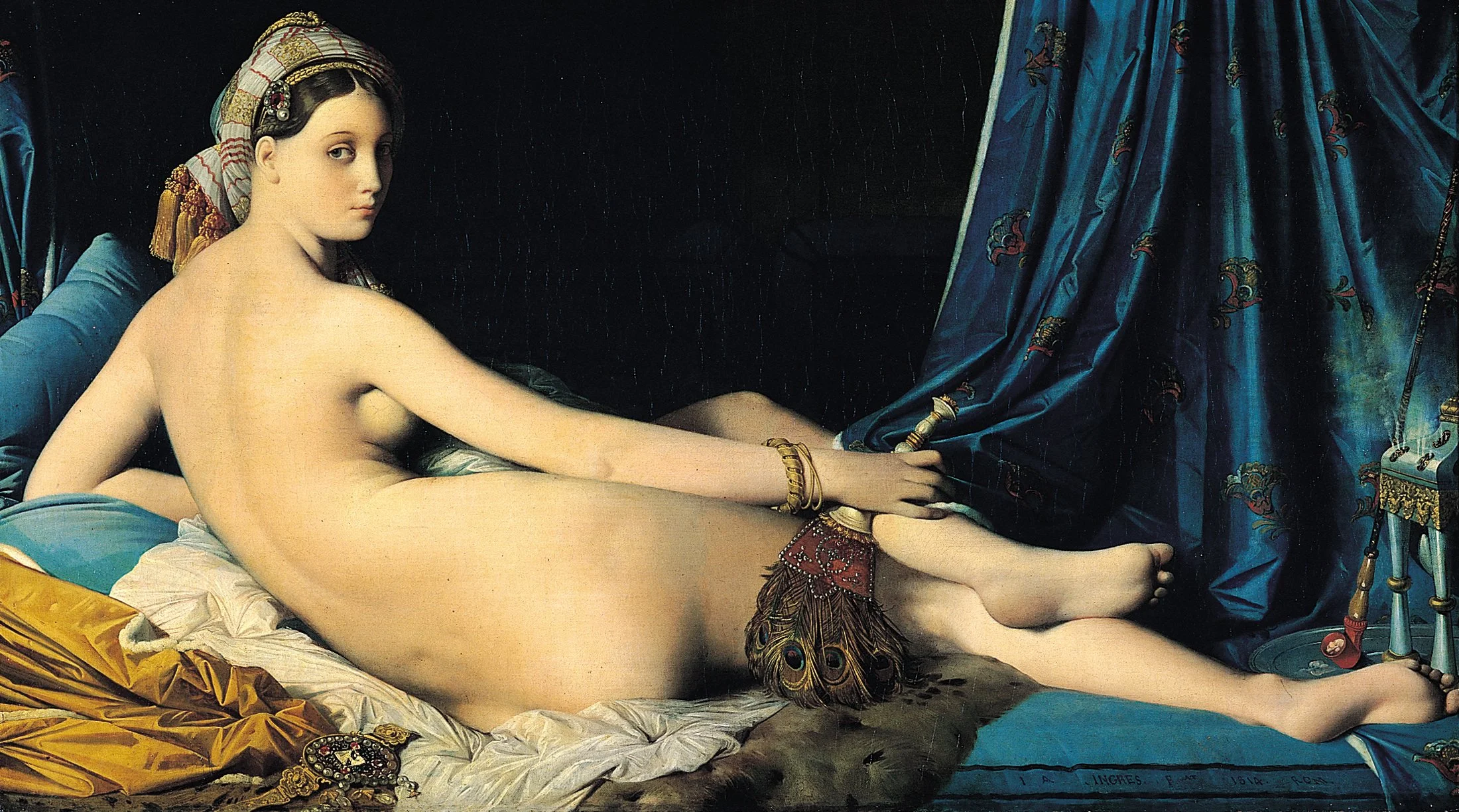

From a dark corner of a boudoir, the suspicious eye of an odalisque gazes out from over her shoulder. The luxurious interior points to the fashion for exotic concubines – the headdress, silk embroidered curtains, peacock feathers, hooker pipe and bejewelled medallion in the foreground. There is a tension between the softness of the fabrics and the porcelain skin of the subject, against the hard stare and lack of expression. This painting has always held such beauty and mystery for me, that I’m very pleased to uncover its meaning here.
An odalisque is a concubine living in a harem, and this painting is a European idea of what a harem would look like – a fantasy of sensuality and exoticism. Tales of travel and Oriental scenes were very popular by the early 19th century, as a result of Napolean’s campaigns in Egypt and Syria and La Grande Odalisque was commissioned by no less a person than Queen Caroline of Naples, Napolean’s sister. By the time the painting was completed, Napolean had been deposed and Caroline was no longer Queen of Naples.
Painted in 1814, Ingres would have drawn inspiration from Portrait of Madame Recamier, painted in 1800 by his teacher Jacques-Louis David. After winning a prize, Jean-Auguste-Dominique moved from Montauban in Southern France to study in Paris with the classical artist. He made his Salon debut in 1802, winning the Prix de Rome and by 1806 was studying in Rome, being drawn to works such as Dresden Venus by Giorgione and Titians supremely sensuous, Venus di Urbino for further inspiration. Ingres remained in Italy from 1806 – 1824, painting in Rome and then in Florence in a style reminiscent of the Italian and Flemish masters – a style that would change little throughout his career.
When La Grande Odalisque was shown at the Salon in 1819, it was highly criticised for its anatomical distortion. The proportions were not accepted, and neither were the mix of both classical and romantic styles, critics claimed that Ingres had painted three extra vertebrae and that the figure lacked muscle tone, with one remarking that the work had “neither bones nor muscle, neither blood, nor life, nor relief, indeed nothing that constitutes imitation.” But the artist insisted he had abandoned realism in order to create the languid mood, citing the influence of Mannerism from Parmigianino and his use of a cool palette.
Art historians have continued to be intrigued by this question of proportionality, with in-depth studies proving that La Odalisque was painted with a curvature of the spine and rotation of the pelvis that would be impossible to achieve in real life. Their measurements prove that her left arm is shorter than her right and that Ingres would have needed to increase the spine by five vertebrae. Whatever their findings, the artists expressive (and purposeful) distortions of form and space made him an important precursor of modern art, influencing Degas, Matisse, Picasso and other modernists.
Ingres considered himself a neo-classical history painter, and was firmly against the ascendant Romantic style of the time. Although commissioned for a handful of historical paintings, he is best known for his female nudes and notable work in his later years. Charles Baudelaire writes, “A peculiar fact about the talent of Monsieur Ingres is that he seems to prefer painting women. His eye follows the most delicate curves in their outlines with the slavishness of a lover.”
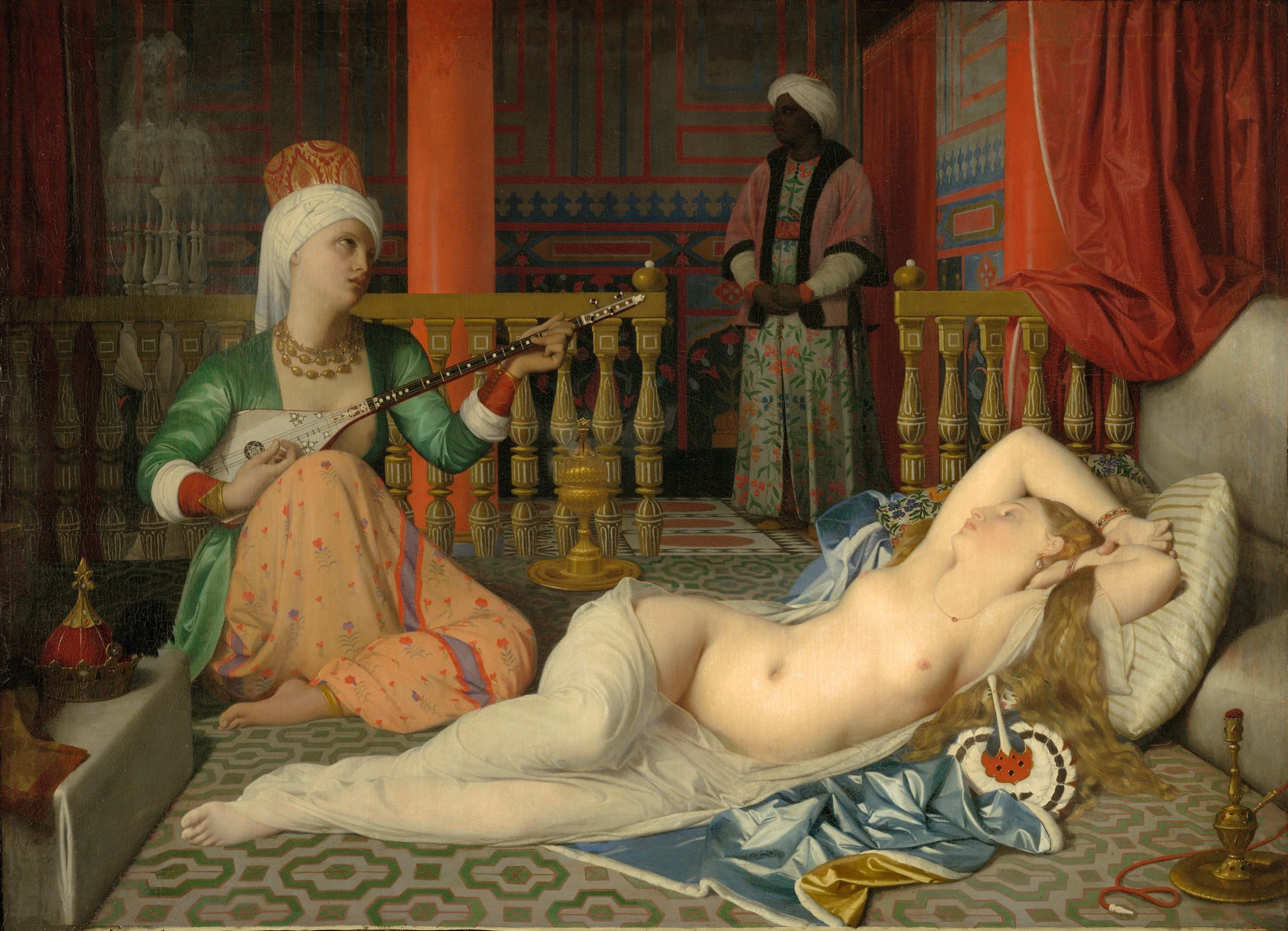
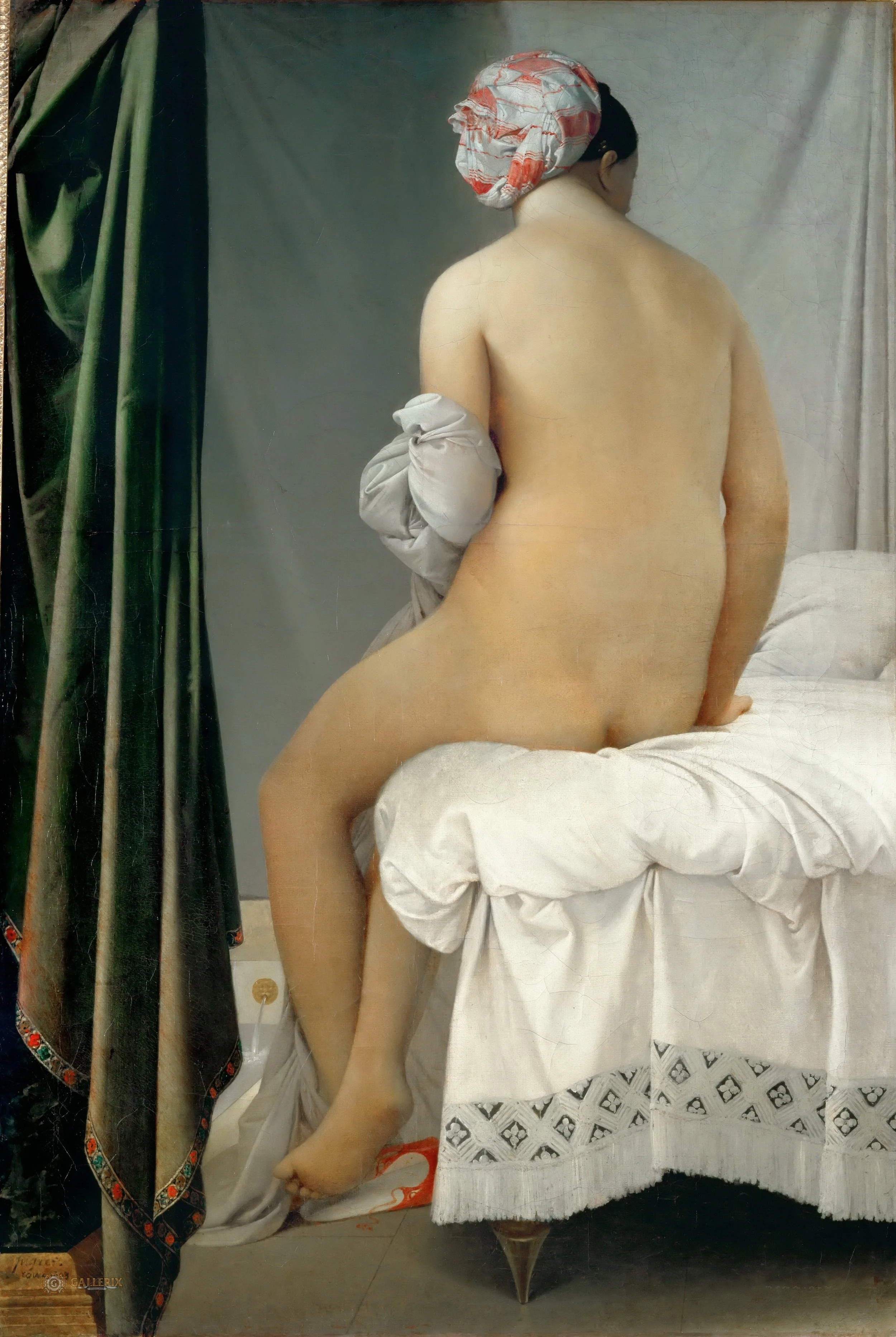
Finally returning to Paris for good in 1841, he painted new versions of his earlier compositions, several important portraits of women and The Turkish Bath, the last of his Orientalist paintings which he finished at the age of 83 – a truly epic piece. He would certainly have been stunned to see the feminist art group, Guerrilla Girls, using La Grande Odalisque as their first colour poster in that indelibly iconic image that we all recognise. In 1989 the Metropolitan Museum poster gave her a gorilla mask and posed the question, “Do women have to be naked to get into the Met?” I have a sneaky suspicion that he would have approved.