Recreating the Colour Palette of Paula Modersohn-Becker
written for Jackson’s Art Blog ~ May 2026
Paula Modershon-Becker (1876 – 1907) produced more than 700 paintings and 1000 drawings in her short life, dying after the birth of her child, Mathilde, aged just 31. The catalogue of work she left behind is a testament to her devotion to art and her quietly radical determination to chart her own path in the pursuit of artistic freedom. Her life is a moving story of a courageous young woman, with unerring faith in her own ability, breaking boundaries in the face of conservatism at the turn of the century.
Modersohn-Becker is understood to be the first known female artist to paint herself nude and pregnant and was an important figure among the early German Expressionist painters. She surrendered her marriage to pursue her calling, leaving her husband and escaping to Paris, an important centre for fine art education at this time. The vision she held for her life was, sadly, never realised, however one cannot fail to admire her bravery and single-mindedness seen through her collection of letters and journals, written with great self-awareness and sensitivity.
Prior to her time in Paris, she had studied at traditional schools in London and Berlin, before settling in 1898 in Worpswede, an art colony on the north-German moors. Here, a group of artists devoted themselves to naturalist painting, very much seen as wealthy outsiders by the poor locals who lived there. This was a seminal time in her artistic development, painting outdoors rather than in the studio and studying under Fritz Mackensen. The ethos of the group was an escape from industrialisation, learning to paint from nature, developing a sentimental and melancholic style in a dark and earthy palette, typical of Northern European painters. She developed a romantic attachment to Otto Modersohn, the founder of the colony, falling in love with him and the landscape, describing it as ‘a wonderland of gods.’
Her early works can be easily identified by their subject matter and tonal palette. She became interested in capturing the inner expression of local peasants and farm workers and does so with an honest beauty. Note the solemnity and dignity in ‘Sitting Old Peasant Woman’, 1903, a very beautiful painting. The same honesty is extended to ‘Half-length portrait of an old farmer,’ 1903, tempera on canvas, exhibiting her skill as a portraitist. She also showed great aptitude for still life, see ‘Still-Life with a Green Flower Vase,’ 1902. From around 1905 – 7, she produced almost 50 still lifes.
Her muted palette of ochres, browns and deep greens reflects the landscape and Northern European tradition of painting with a limited palette and is associated with the Dutch Golden Age. This 17th-century tradition of low-toned palettes and tonal approach using browns, greys, greens and ochres to create atmospheric, naturalistic and contemplative scenes directly influenced the Worpswede group.
Consider Van Gogh’s early work, The Potato Eaters, 1885, painted using an ‘authentic’ earthy palette to depict the De Groot family of local farmers and the honest potato. How significant then, in the cases of both Van Gogh and Modersohn-Becker, that their palettes lighten and become more vivid when he moved to Arles and she moved to Paris. Paul Cezanne and Vincent van Gogh were to prove aspirational figures to this young artist, and the body of work she created at the colony was ahead of its time.
Having married Otto in 1901, she became a stepmother but refused to give up painting, defying conventions at the time. She struggled with the monotony of rural married life, writing in 1902 that she felt ‘doubly misunderstood’ – she dreamed of a life beyond Worpswede and so, on 1st January, 1900, Modersohn-Becker made a seventeen-hour train journey to Paris, alone. It was a trip that would change her life. As the epicentre of artistic exploration, many artists felt its pull.
She thrived in the fast-paced city, absorbing all the paintings at the Louvre and soaking up creative inspiration. She continued to travel back and forth from Paris to Germany over the course of six years, until finally, in 1906, stifled by rural life and yearning for modernity, she left Worpswede and her husband Otto. ‘I have left Otto Modersohn and stand poised between my new life. What will it be like? And what will I be like in my new life? Now it is all about to happen. I am becoming something – I am living the most intensely happy time of my life.’
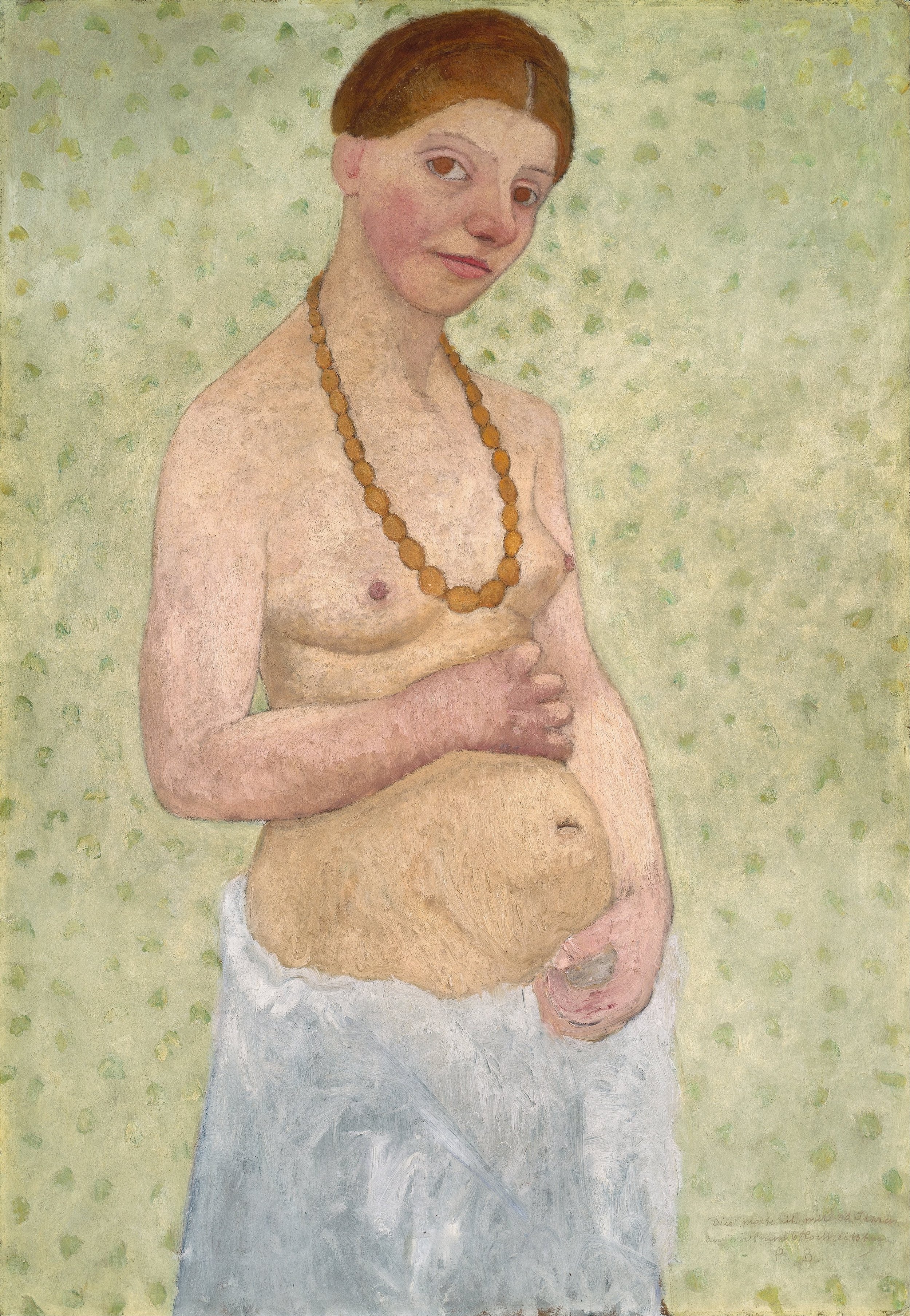
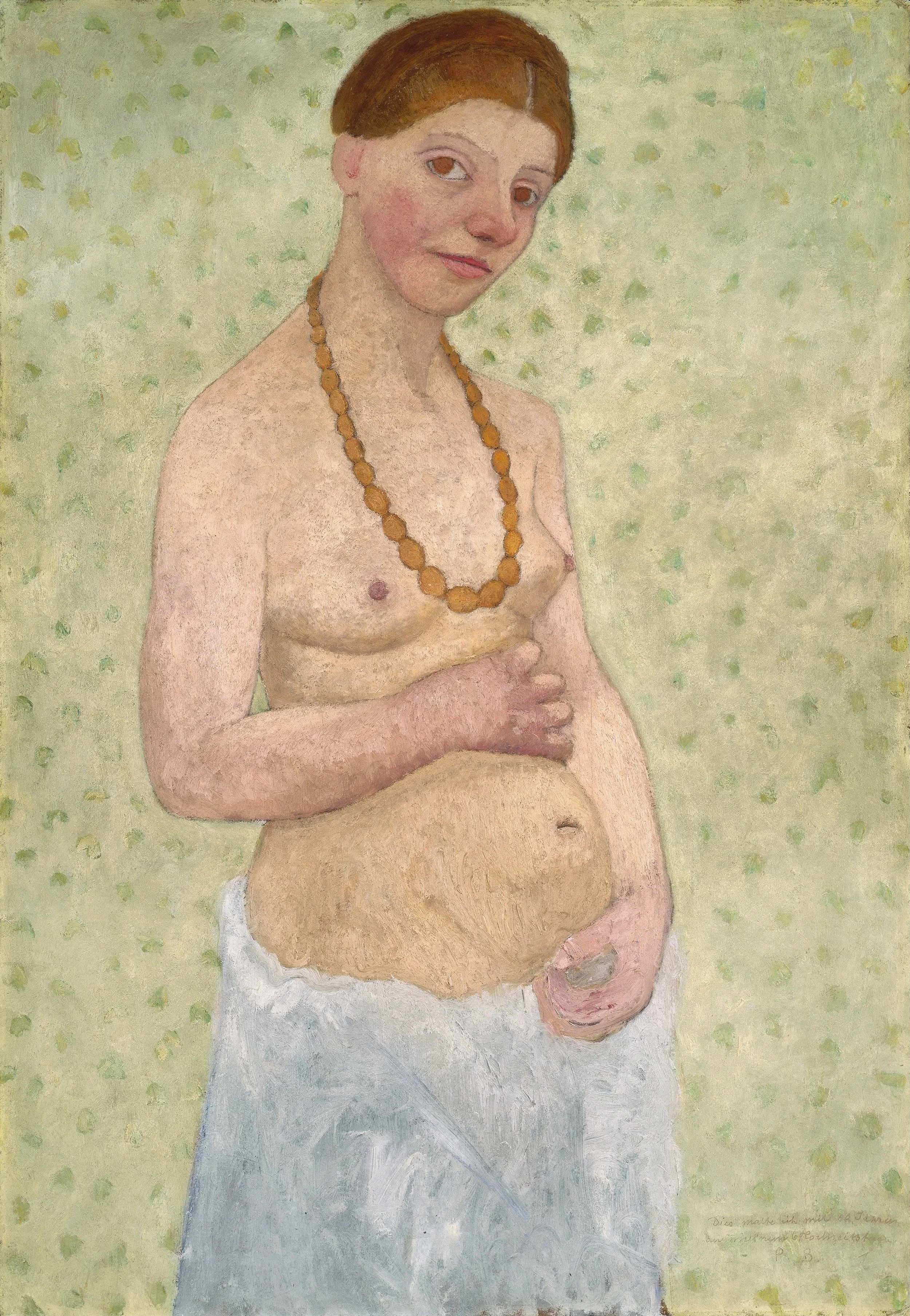
‘Self-Portrait, Sixth Wedding Anniversary’, 1906 by Paula Modersohn-Becker
It is no surprise, then, that she produces one of her most recognisable pieces in the same year, ‘Self-Portrait, Sixth Wedding Anniversary’, 1906, along with dozens of expressive paintings and self-portraits as a woman revelling in her independence. In this piece, she works in a lighter palette of clean pastel tones, reflecting her newfound happiness. It is as if the sun is finally shining on her – these are works that were unprecedented for female artists. This is considered to be one of the first semi-nude self-portraits in Western art, painted by a woman. What looks like a pregnancy is, in fact, a metaphor for her burgeoning new life.
‘And now here I am living here in the bustle of this great city. Everything rushes and swirls around me in a damp and foggy atmosphere. … I feel blissfully clear and serene. I can feel a new world arising in me.’
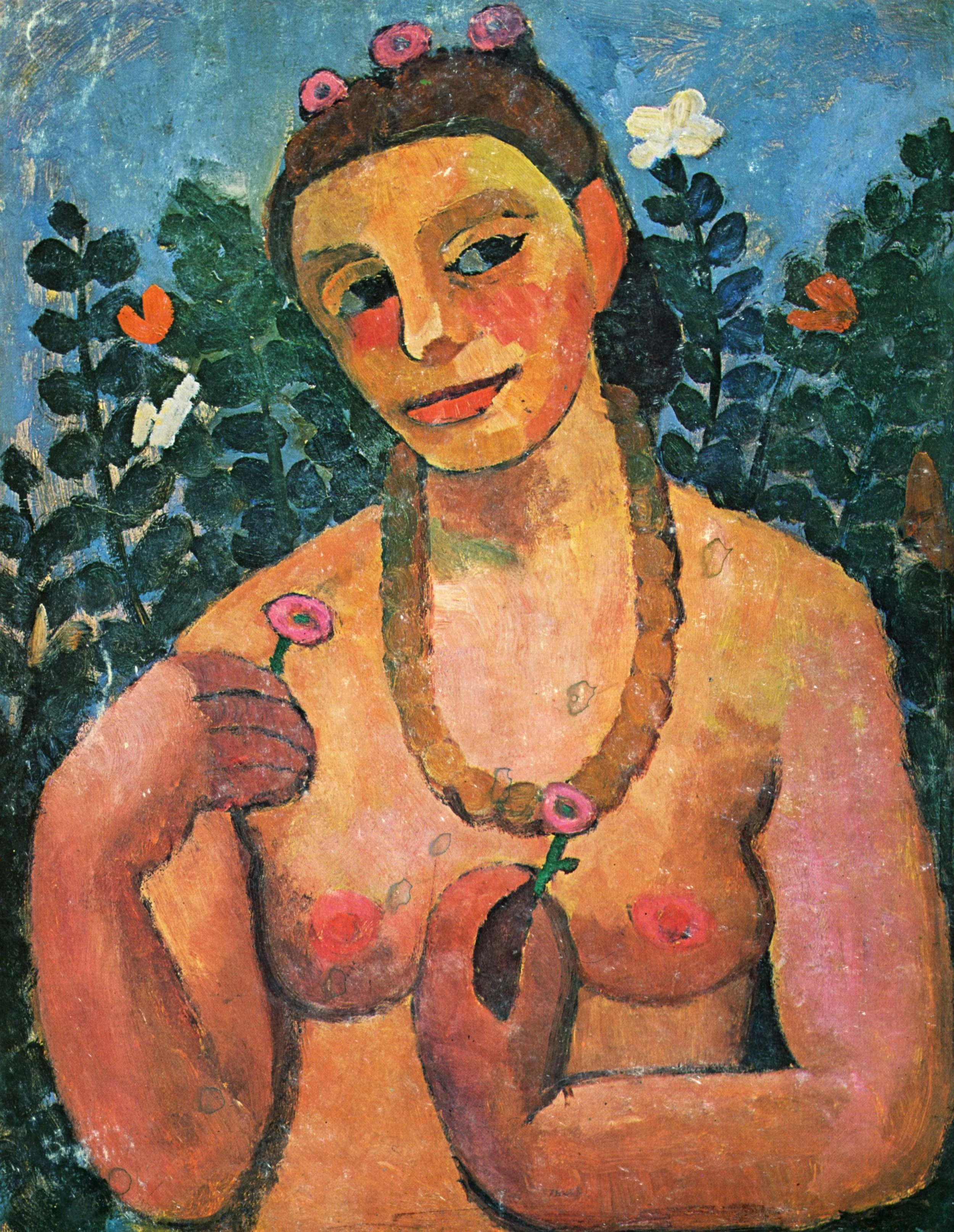
Her change of mood and Fauvist colour palette can also be seen in
‘Self-Portrait: Nude with Amber Necklace Half-Length II’, 1906 – a work that was influenced by Dante Rossetti.
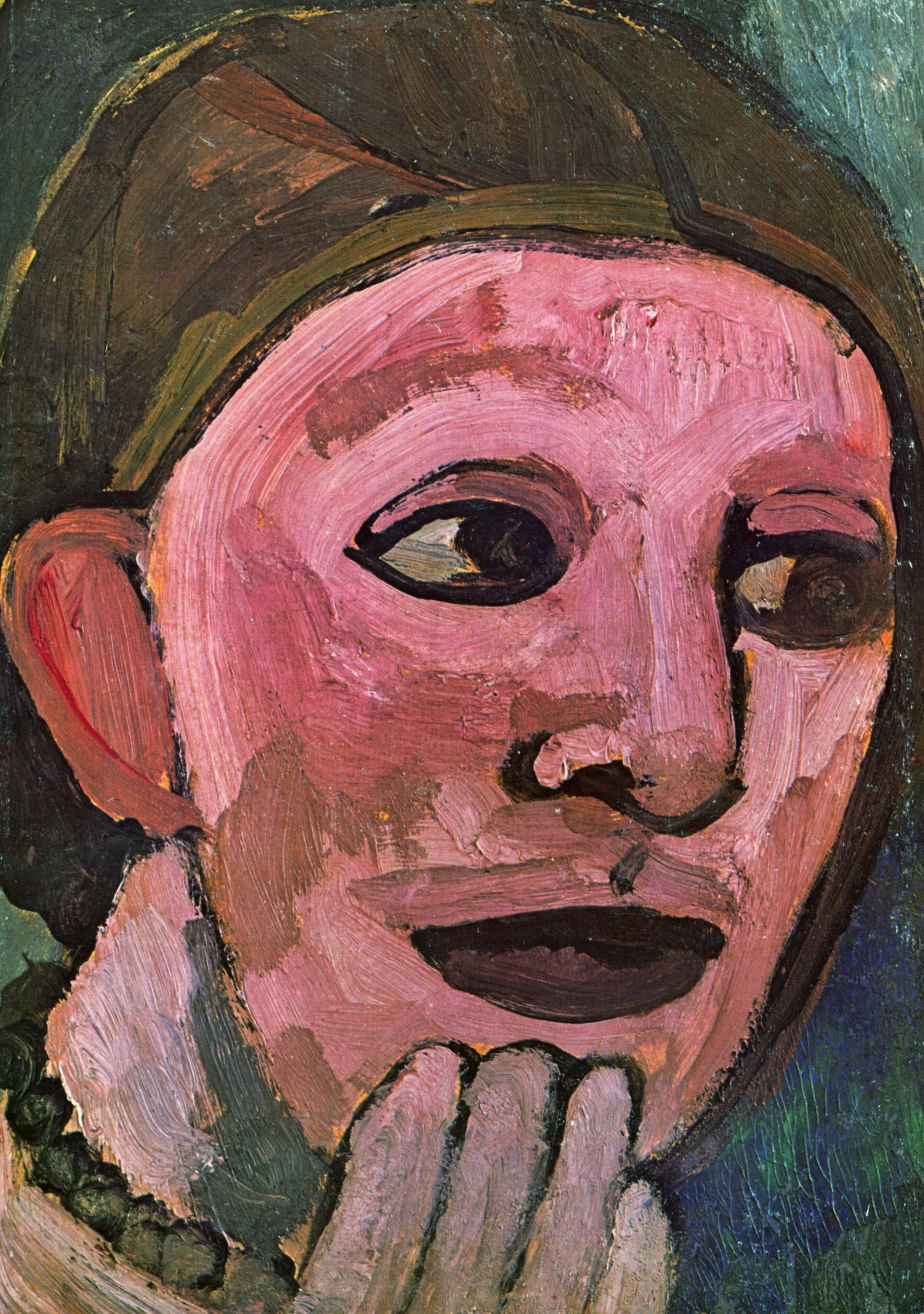
‘Self-Portrait with hand on chin,’ 1906, oil on panel
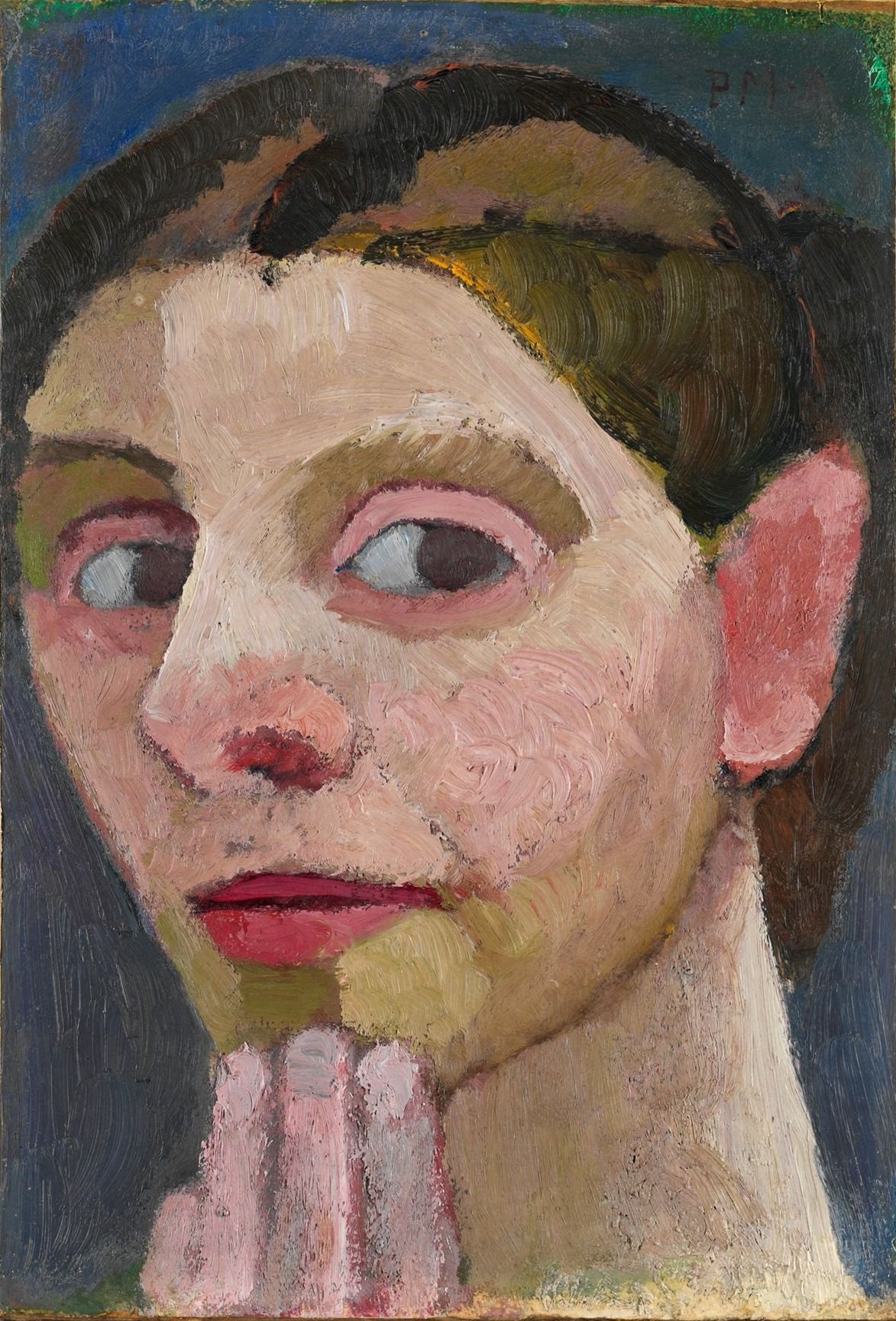
‘Self-Portrait,’ 1906 – 7, tempera on paper
‘Old poor woman with a glass ball and poppies,’ 1907. Pigment analysis of this Fauvist artwork shows traces of Zinc White, Cadmium Yellow, Viridian, synthetic Ultramarine and Red Ochre.
‘Self-Portrait with a camellia branch’, 1907
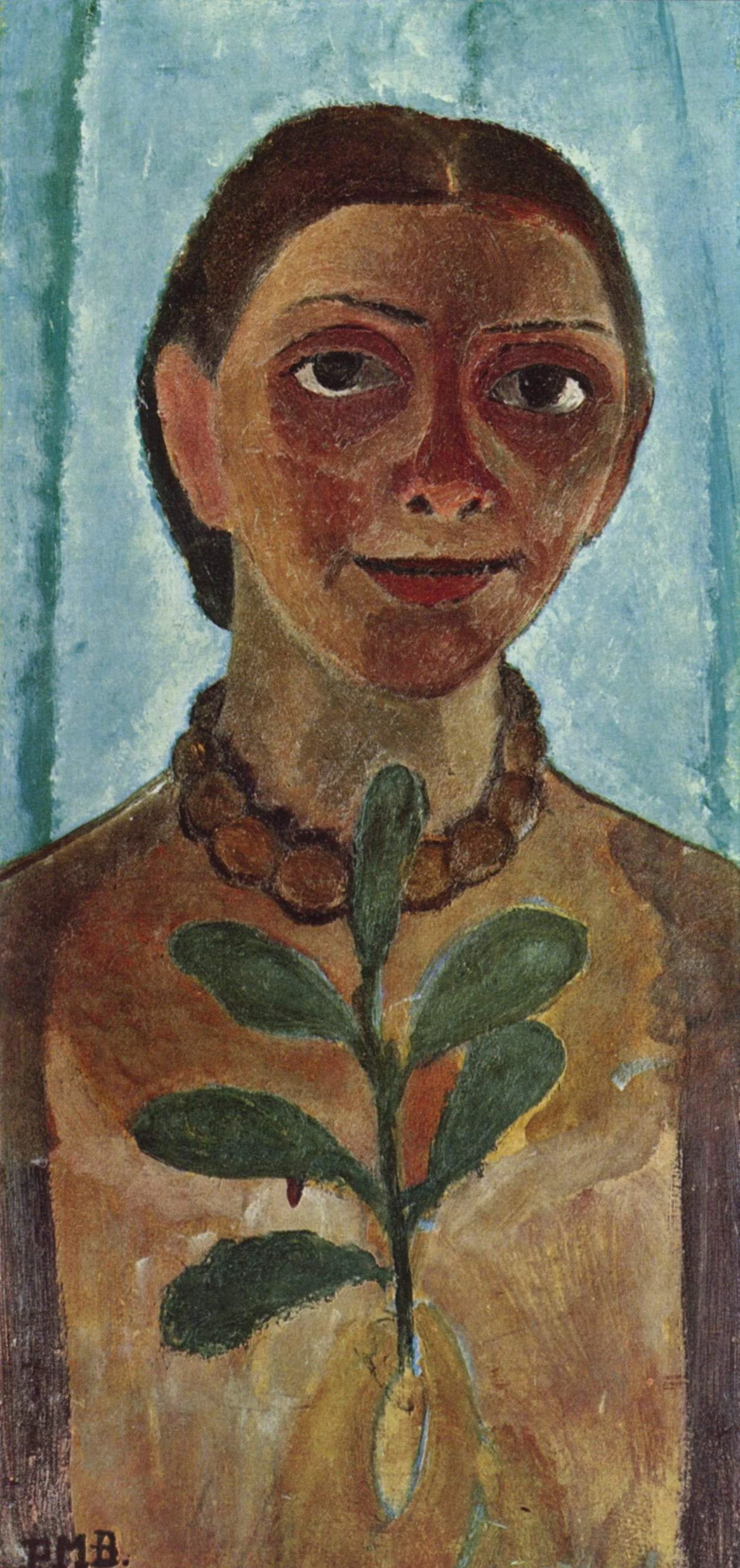
‘Self-Portrait with a camellia branch’, 1907
In this serene self-portrait, Modersohn-Becker holds a camellia branch as a symbol of the natural life cycle, living and dying, blossoming and withering. Her distinctive, large, almond-shaped eyes and half-smile stare out at the viewer, with a knowing and tender submission. A diary entry from July 1900 is almost a premonition for what comes next: ‘I know that I won’t live very long. But is that sad? Is a festival better because it’s longer? And my life is a festival, a short, intensive festival.’
Painted in Paris, it is all the more poignant as her last ever painting. Just seven months later, she was dead. Between 1906-7, she produced a collection of incredibly expressive artworks, but sadly, due to limited finances, she returned to Worpswede and gave birth to her daughter Mathilde. Just a few weeks later, following a postpartum pulmonary embolism, she died, leaving behind hundreds of artworks, never achieving recognition in her own lifetime. She was, however, championed posthumously with a solo exhibition in Berlin in 1919 and in 1927, the Modersohn-Becker Museum opened in Bremen, the first ever in Europe devoted to a female painter. Despite Nazi criticism of the museums ‘degenerate art’, the monument remains.
German Expressionism and the Modersohn-Becker palette at the turn of the century
‘I love colour. It must submit to me. And I love art. I kneel before it, and it must become mine. Everything around me glows with passion. Every day reveals a new red flower, glowing, scarlet red.’
The time in which Modersohn-Becker lived is significant in the development of her artistic practice. Creative women at the turn of the century were afforded much greater access to a fine art education than ever before. Previously closed to females, life drawing ateliers allowed women to join, and Universities and fine art institutions finally offered places to women. The Slade School of Fine Art in London was one of the most progressive, opening its doors to women in 1871, the Royal Academy Schools opening their life classes to women in 1893 and the École des Beaux-Arts in 1897. Modersohn-Becker took drawing classes at the Julian Academy and benefited from new creative friendships with professional female painters.
Modersohn-Becker’s work anticipated many of the powerful ideas that would develop in the German Expressionist Movement (1905 – 1930). As a direct response to modern industrialisation and the First World War, these avant-gardes sought to represent inner psychology over realistic representation, by using vibrant clashing colours, quick and energetic brushstrokes and raw emotion to evoke a visceral response. Becker used oil and tempera, frequently scratching into the wet paint to create texture, disrupt the surface and relieve tension.
She began to experiment with a vibrant Fauvist palette, often using unmixed colours straight from the tube. One of her favourite colours was the new, synthetic ultramarine, also known as French Ultramarine, created by the French chemist Jean-Baptiste Guimet in 1824. By the 1870’s, the relatively new and exciting ultramarine blue had become affordable and accessible to artists in collapsible tin tubes. The Fauves, or ‘Wild Beasts’, led by Henri Matisse and Andre Derain, used non-naturalistic bold colours using spontaneous brushwork (see Woman in a Hat, 1905, by Matisse represented by a green face) highly influenced Modersohn-Becker and gave her permission to experiment with colour in new and exciting ways. Colour exploration was top-of-mind amongst the modern French painters, and Matisse in particular studied colour theory in great depth. His key findings included a liberation of colour from reality, colour as structure using contrasting areas of flat, pure colour, the power of complementary colours and using colour to represent emotional expression. These ideas are now accepted and understood as commonplace in modern art society, but at the time, they were quite radical - Modersohn-Becker would have been exposed to and influenced by these ideas. Her paint application became loose and more energetic, and her use of pure and primary colours is evident, as are the dark outlines that have a Van Gogh quality to them.
Although her life was cut short, she left behind hundreds of letters and journals which form a picture of a woman on the cusp of an exciting life as an artist. We can glean much information about her inspiration and practice as an artist from these documents.
‘I’m living here in a large, bright atelier. I love to fall asleep among my paintings and wake up with them in the morning. I’m painting life-size nudes and still lifes. My paintings look so dark and muddy here. I must get much purer colours.’
Perhaps a leading edge of the Modernist movement to come, her life was over far too soon. We can see her work and palette developing, already with a distinctiveness that is unusual in one so young. Over the course of ten intensive years, she sold just a handful of paintings yet left behind hundreds. Her work on the female nude and representation of women and children is unconventional, significant, tender, but never saccharine. (See ‘Reclining Mother and Child’, 1906) She struggled to balance her artistic ambition with gender expectations. She walked away from the life she was expected to live, and for that we are grateful.