Le Dejeuner sur l’Herbe
by Edouard Manet
written for The Artist magazine ~ August issue 2026

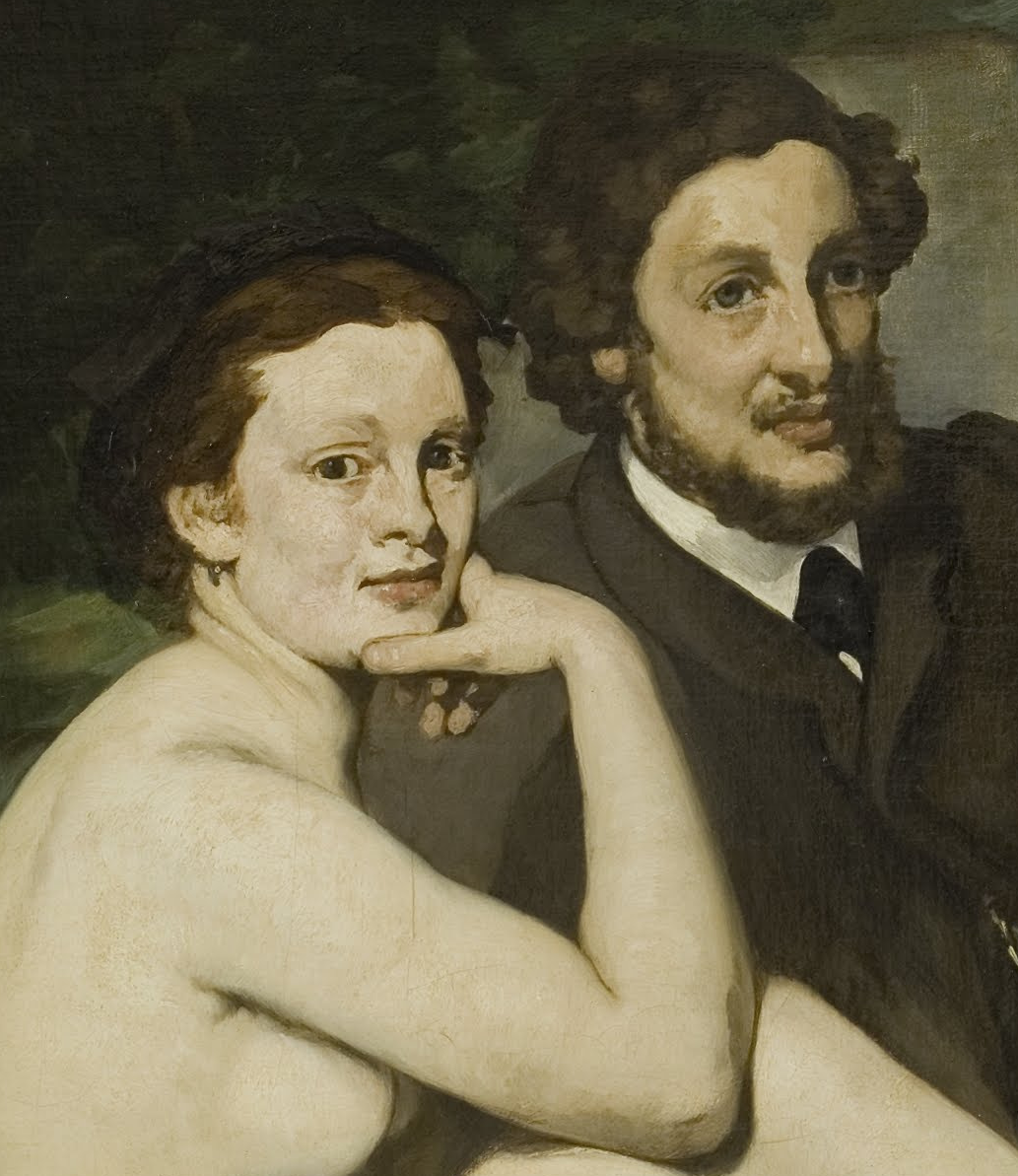
What makes Le Dejeuner sur l’herbe such a famous painting? Those who come across it with no prior knowledge of its backstory find it… confusing at best. Calling it an infamous painting would be a much more accurate description. The contemporary eye finds it obscene in its objectification, much like the French audience at the time of its conception.
This painting is one of art history’s best-known succes de scandale.
It became one of the most famous scandals in art history when it was exhibited as Le Bain at the Salon des Refusés in 1863, having been rejected by the official Paris Salon. The Salon des Refuses ran in parallel to the Salon de Paris, showing works that had not made the cut in the traditional setting. It was all good PR as far as Edouard Manet was concerned, a young thirty-year-old painter looking to find a name for himself in the city. Ambitious from the off, he studied under Thomas Couture for six years before opening his own studio. The responsibility of a young son, born when Manet was just twenty years old, galvanised his desire for financial success.
Le Déjeuner sur l’herbe was shocking and eye-catching not only for its subject matter but also for its composition and technique. Visitors to the Salon des Refusés criticised it for being an offensive mixture of nude and clothed figures, despite Manet’s deliberate references to Titian’s Pastoral Concert and Raphael’s Judgment of Paris. Nudity wasn’t taboo as a subject in itself, especially if it was justified by a mythological subject, but this? Here was a scene with two elegant Parisian dandies in their finest clothes out on a Sunday excursion, conversing with a self-confident, unabashed modern woman. She is not a nymph, and she is certainly not timid. In fact, she is staring directly out of the canvas towards the viewer – how bold!
Then we have Manet’s painting technique, which was considered almost as shocking as his offensive subject matter. Arguably one of the early Impressionists, he was experimenting with sketchy compositions, rapid brush strokes and blurred details. The Salon considered this painting an ‘unfinished work’, such was their confusion at its submission. There is some perspective, but also some flatness – certainly not the kind of accuracy they had come to expect, including careless proportions. The bather in the background appears too big for her surroundings. Despite these controversies, the painting had some fans including the young painters of Paris who were pushing boundaries and would become the new wave of Impressionists. Emile Zola says, ‘This painting…has a broad, substantial foreground and a lightness and delicacy of background. It is a little corner of the countryside rendered so simply but so exactly.’
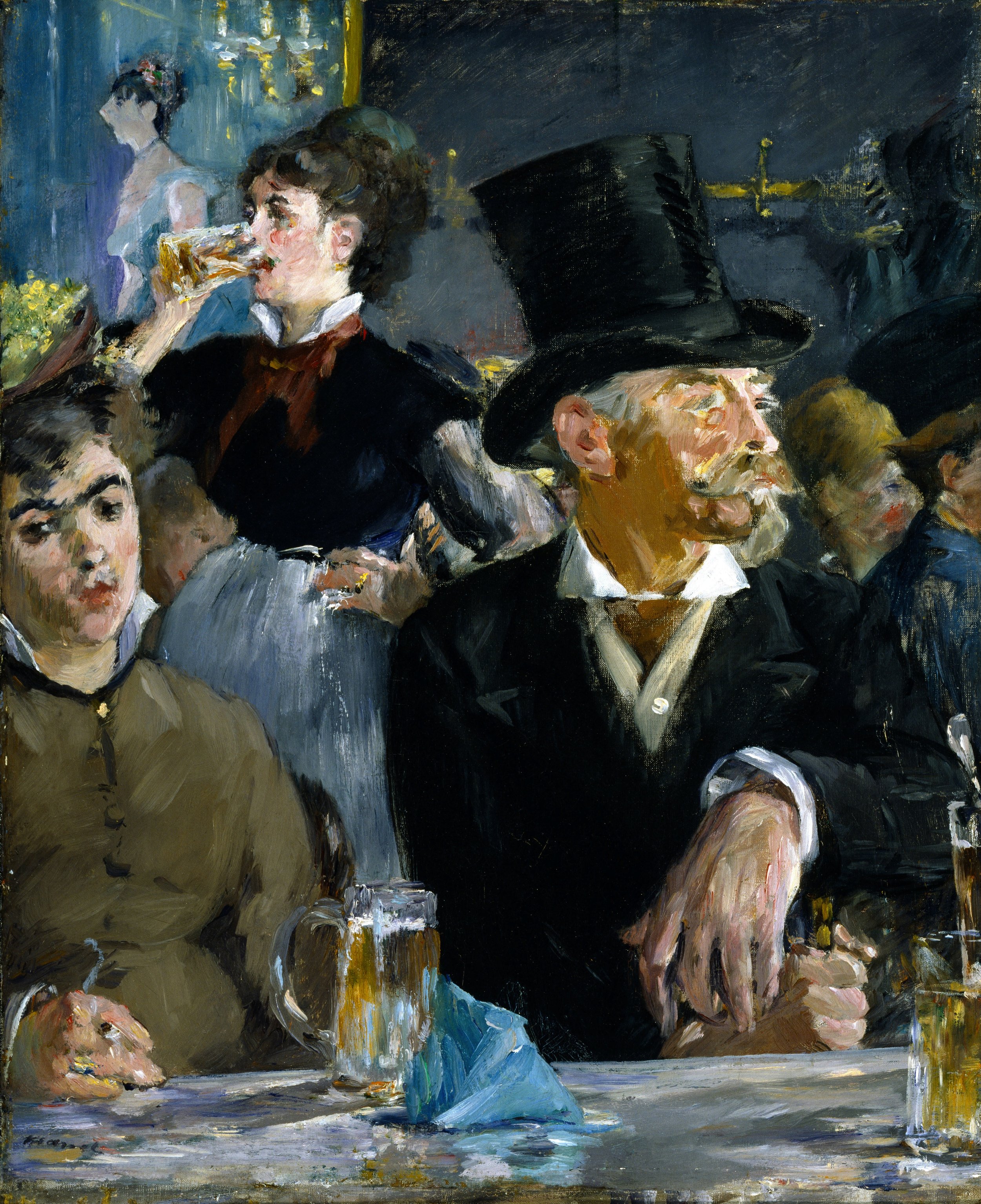
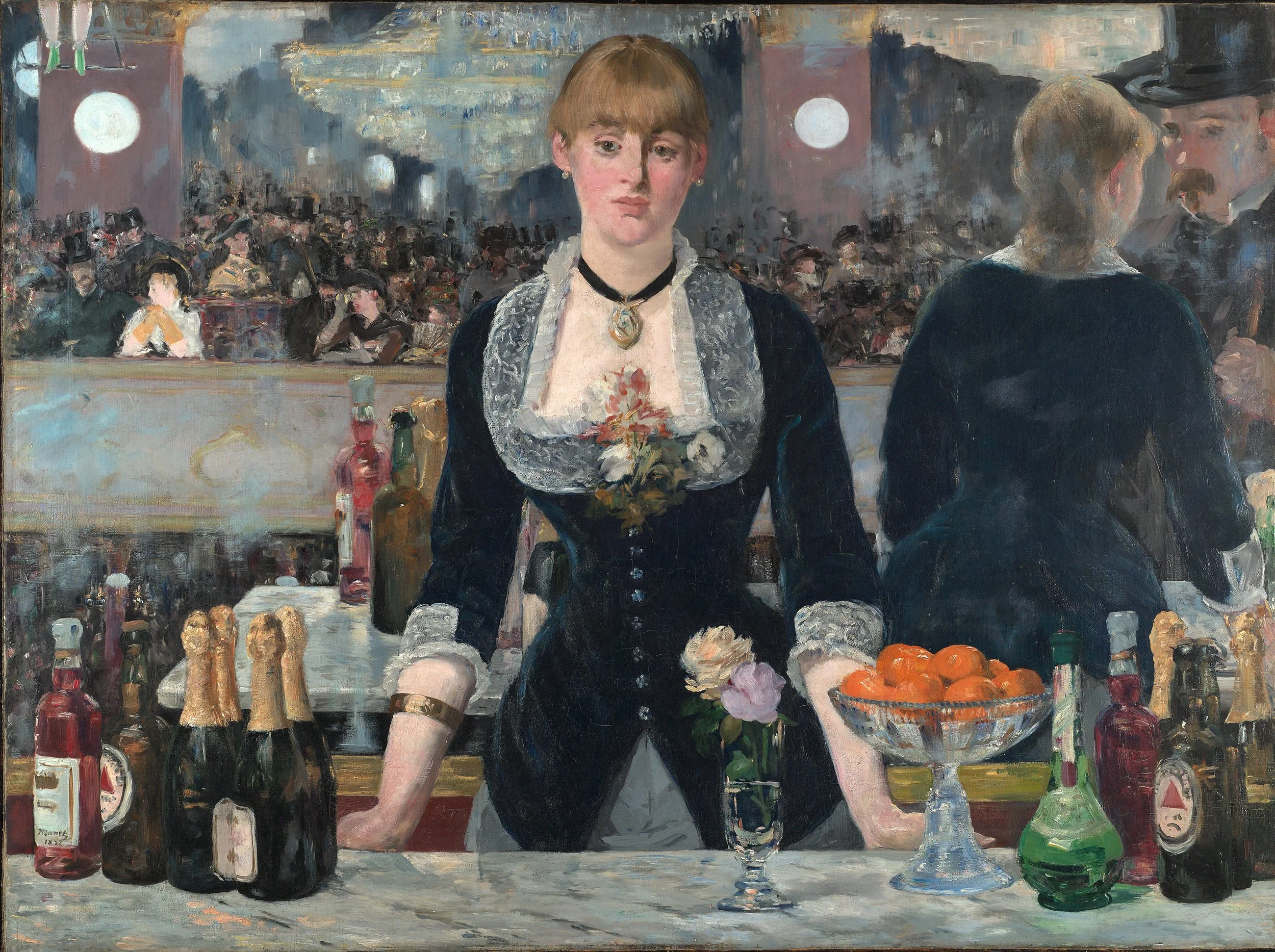
Manet was concerned with capturing the essence of Parisian life at that time, seen so successfully in Au Café and Au Bar a la Folie Bergere for which he is best known. Widely regarded as ‘the painter of modern life,’ transitioning from realism to impressionism, he frequented the vibrant chaos of a newly redesigned Paris under Napolean III. There was a raw energy in the crowded city streets, railways, bars, cafes and concert halls. He was the original observer, or flaneur, capturing the societal changes and mingling of classes. A Bar at the Folies-Bergere (1882, 96cm x 130cm) was his final, major work, cleverly depicting a bustling bar in which the barmaid stands frozen in solitude as the world spins around her. Beautifully rendered, with so much detail in the reflection behind her, she is contemplative and stands alongside an array of other alcoholic temptations. The toes of a trapeze artist swing into view in the top left hand corner, while a thirsty customer demands service to the right. Part of the collection at The Courtauld, it’s another important cultural document. He died in 1883, just one year after painting it.
For Manet’s young painter friends, Le Dejeuner sur l’herbe made him an icon and inspired key members of the Impressionist movement, including Claude Monet, Pierre-Auguste Renoir and Camille Pissaro. Although he never took part in their exhibitions, he certainly mentored younger artists and encouraged them to approach painting less traditionally. He was one of the first to paint urban scenes, observing from life - a subject matter and approach which the Impressionists later adopted.
The real genius of Le Dejeuner sur l’herbe is in the artist's confrontation of social norms and bridging classical composition with contemporary Parisian life. By placing a nude woman at the centre of this painting, he is forcing the viewer to consider propriety, sexuality and class. He knew it would encourage debate and challenge convention and he was not wrong. Why not take a trip to the Musée d’Orsay and take a closer look for yourself?
There is an accompanying film available to view on Painters Online for Studio Members. https://www.painters-online.co.uk/membership/